

Google Ads Channel Prioritization: A Guide for Advertisers
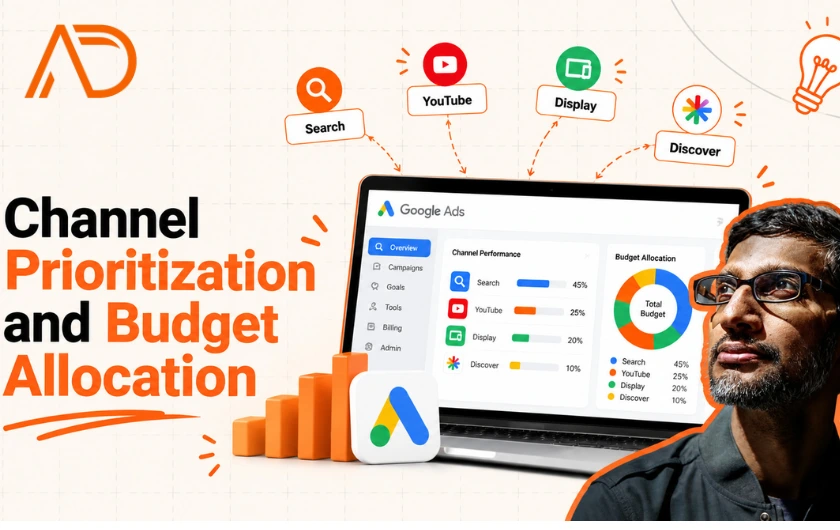
Google Ads Channel Prioritization: A Guide for Advertisers Google Ads channel prioritization is a new feature that lets you decide where your ad budget gets spent first, and where it get spent less. If you have ever wondered why some of your money ends up on Search Partners or the Display Network when you never really asked for it, this update is for you. Google announced this in October 2026, and it’s being released around the world in the months ahead. Here’s a simple explanation of what it means. What Is Google Ads Channel Prioritization? Think of your ad budget like a single container of money. In the past, Google made most of the choices about how to divide that money across different channels, and you had little control over it. With channel prioritization, you can mark each channel as either High priority or Low priority. Google then spends on your high-priority channels first. Whatever budget is left can move to the low-priority ones, while Google still tries to hit your Target CPA or Target ROAS. Here’s a simple example. Say you run a Search campaign. You can set Google Search as high priority, and put Search Partners or the Display Network in the low-priority group. One thing to remember: every channel starts as High priority by default. So if you don’t change anything, nothing changes. The choice is yours to make. How Does Budget Allocation Work? This is the second half of the update, and honestly, it’s the more useful part. Budget allocation lets you put a percentage limit on how much of your daily budget can go to low-priority channels. So if you want to test Search Partners but don’t want it eating up your whole budget, you can set it to Low priority and cap it at 20%. There are two things worth knowing here. First, Google says it will follow these limits on a best-effort basis. So treat the percentage as a strong guide, not a locked door. Second, you can also set a channel to 0%, which tells Google not to spend on it at all. That includes inside Performance Max, which is a big deal for advertisers who have wanted more control there. It also works when your campaign isn’t limited by budget. So even if you have plenty of budget available, you can still control how much goes to certain networks. Which Campaigns Get These Controls? The new controls are coming to Search, Shopping, Performance Max, and Demand Gen campaigns. You can set your priorities at the account level, with separate defaults for each campaign type. You can also change them for a single campaign, and that campaign setting will override the account one. The controls work with shared budgets too, and Google says API support will be available from day one. There’s one catch with Performance Max and Demand Gen. Google groups its own channels together there, which means Search, YouTube, Discover, Gmail, and Maps move as one block. You can’t prioritize them one by one. Google is also running a small separate test of more advanced Performance Max controls, so this may grow over time. What Changes for the Display Network in February 2027? What Changes for the Display Network in February 2027? If you run Search campaigns with the Display Network turned on, this part matters. Right now, Google already puts Search ahead of Display behind the scenes. In February 2027, Google will retire that old setup. And since the new system starts everything at High priority, your spending could shift between networks if you do nothing. Google’s suggestion for keeping things the way they are today is to set the Display Network to Low priority with a 50% budget allocation. There will also be a one-click migration option when the new controls launch, so you won’t have to rebuild everything by hand. Should You Change Your Settings Right Now? Probably not in a rush. If your campaigns are already hitting their CPA or ROAS targets, limiting channels could take away room that Google’s bidding uses to find conversions. In other words, if it isn’t broken, be careful about fixing it. Where this update helps most is for advertisers who have avoided Search Partners or the Display Network completely because of traffic quality worries. Now you can test them with a small cap instead of a hard yes or no. Reporting is the other thing to keep in mind. Performance Max already shows channel-level reporting, but Google says more detailed channel reporting for Search is expected in the first quarter of 2027. Until then, you can keep using network segmentation in Search to see what’s working. A Simple Way to Start Testing You don’t need to overthink this. Here’s an easy way to begin once the controls reach your account. Step 1: Look at your current results by network, so you know your starting numbers. Step 2: Leave your best-performing campaigns alone for now. Step 3: Pick one campaign and test a channel you’ve been unsure about. Set it to Low priority with a small cap, around 10 to 20%. Step 4: Give it enough time to collect data, then compare the cost per result with the rest of the campaign. Step 5: Before February 2027, review any Search campaign that has the Display Network turned on, so your spending doesn’t shift without you noticing. Google Ads Channel Prioritization: Frequently Asked Questions What is Google Ads channel prioritization? It’s a new setting that lets you mark channels as High or Low priority, so Google spends your budget on the important ones first. Will it replace Target CPA or Target ROAS? No. It works alongside them. Google still tries to meet your CPA or ROAS goals while following your priority settings. Are the budget limits strict? Not exactly. Google says it will try to stay within your limits on a best-effort basis, so they work more like a strong guide than a hard cap. Can I stop spending on a